
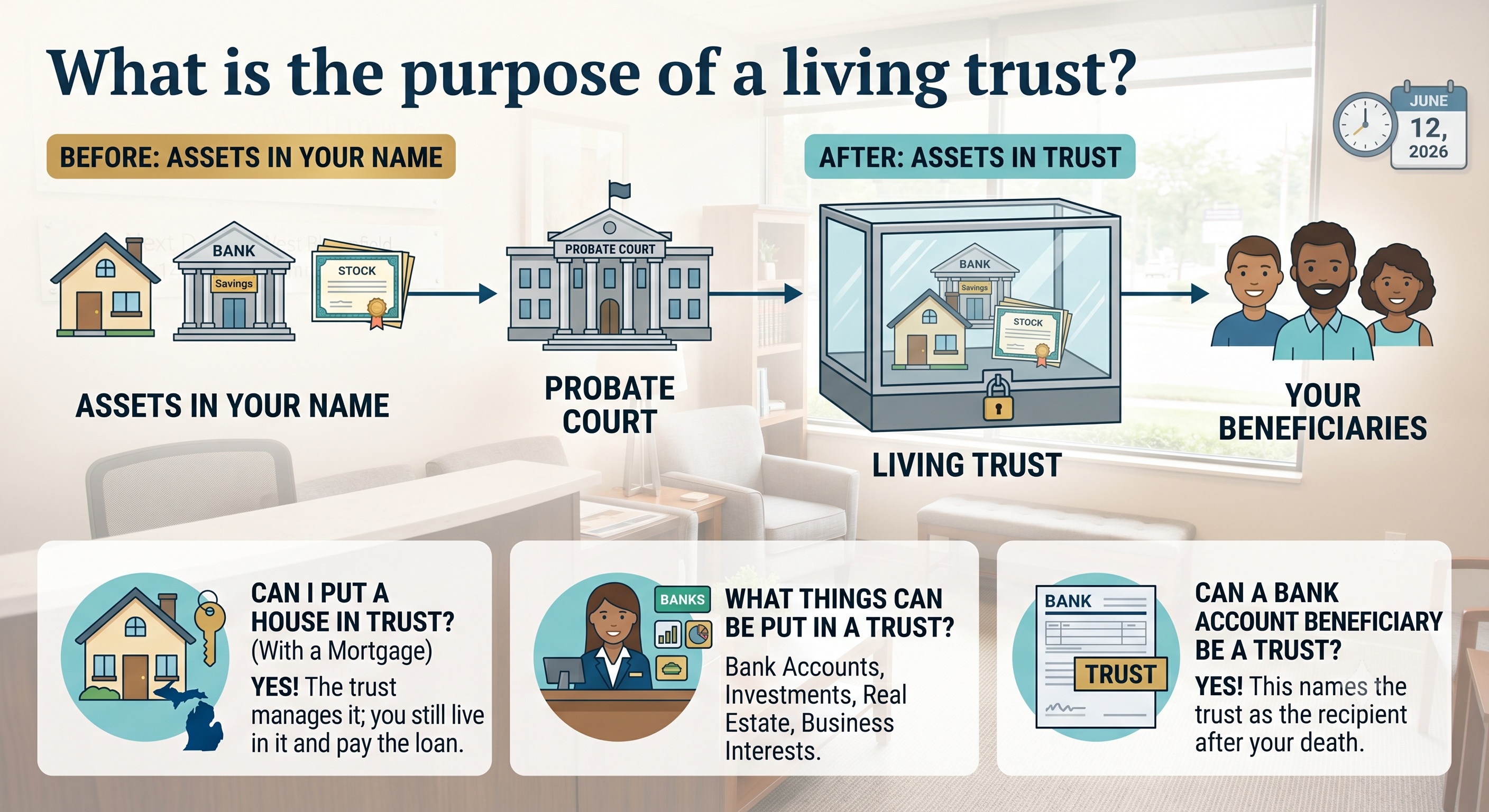
In the simplest terms, the purpose of a living trust is to manage your assets during your lifetime and then ensure a private, efficient transfer of that property to your chosen beneficiaries after your death, completely bypassing the probate court process. Think of it as a specialized "holding company" for everything you own, where you are the initial manager and the primary beneficiary, but which has pre-set instructions for who takes over if you become incapacitated or pass away.
[Insert the image here, showing a comfortable lobby of a law firm with a digital clock/calendar indicating a current date, confirming its modern relevance.]
Unlike a Will, which only becomes active after you die and must be validated by a public court, a living trust is active the moment you sign it and fund it. By "funding" the trust—meaning you legally transfer ownership of your house, bank accounts, and investments into the name of the trust—you remove them from your probate estate. This privacy is a major advantage for families who want to avoid public scrutiny and the associated time and expense of court proceedings.
Navigating the Specifics of a Living Trust
Q: Can I put my house in a trust if I still have a mortgage?
A: Yes. This is one of the most common questions we hear, and the answer, including right here in Michigan, is a resounding "yes."
When you transfer your home into a revocable living trust, you are changing the legal title (the deed) to your name as Trustee of your trust. This does not trigger the "due-on-sale" clause in most standard mortgages, thanks to federal law (the Garn-St. Germain Act). You are still the one responsible for the mortgage payments, the property taxes, and all the maintenance, just as you were before. The trust simply becomes the owner, allowing the property to pass to your heirs privately, even if a balance remains on the loan.
Q: What kind of things can be put into a trust?
A: Generally speaking, almost any asset you own individually can be placed inside your living trust. The process of moving these assets is called "funding" the trust, and it’s a critical step that must be completed to make the trust effective. Common examples of assets typically placed in a trust include:
-
Real Estate: Your primary residence, vacation homes, rental properties, or vacant land (including properties located out-of-state).
-
Bank Accounts: Checking, savings, money market accounts, and certificates of deposit (CDs) can all be re-titled into the trust's name.
-
Investment Accounts: Brokerage accounts containing stocks, bonds, or mutual funds (held outside of a retirement plan).
-
Business Interests: Your ownership shares in an LLC, a corporation, or a partnership can often be transferred to the trust.
-
Valuable Personal Property: Items like jewelry, art collections, antiques, and family heirlooms can be assigned to the trust through specific schedules.
-
Note: Certain assets, particularly tax-advantaged retirement accounts like IRAs or 401(k)s, should generally not be retitled into a trust, as doing so can trigger immediate, significant income taxes. However, the trust can sometimes be named as a beneficiary of these accounts.
Q: Can a bank account beneficiary be a trust?
A: Yes. You have two main options for connecting a bank account to your living trust, and naming the trust as the beneficiary is one valid method.
-
Re-title the Account: You can formally change the account holder from "Jane Doe" to "Jane Doe, Trustee of the Jane Doe Living Trust." This funds the trust immediately.
-
Name the Trust as Beneficiary: Alternatively, you can keep the account in your individual name and set up a "Pay on Death" (POD) or "Transfer on Death" (TOD) designation, naming the trust as the beneficiary who will receive the funds upon your passing. Both methods achieve the primary goal: allowing the account balance to flow into the trust's control after your death without requiring a probate order, giving your Successor Trustee immediate access to the funds needed for your final expenses and distribution.
Q: Is a Will still necessary if I have a living trust?
A: Yes, but a special kind. Even with a comprehensive living trust, you should still have what is known as a "Pour-Over Will." This "safety net" Will state that any assets you owned in your name at the time of your death that were not properly transferred into your trust should be "poured over" into the trust after a simplified probate process.
It acts as a backstop for assets you may have acquired recently or simply forgotten to fund, ensuring that your entire estate is distributed according to the unified plan outlined in your trust, rather than through Michigan's default state laws for people who die without a Will. A Pour-Over Will is also the legal document where you would nominate a guardian for any minor children.